


Description
Bend Sensor for Hand Gesture Recognition
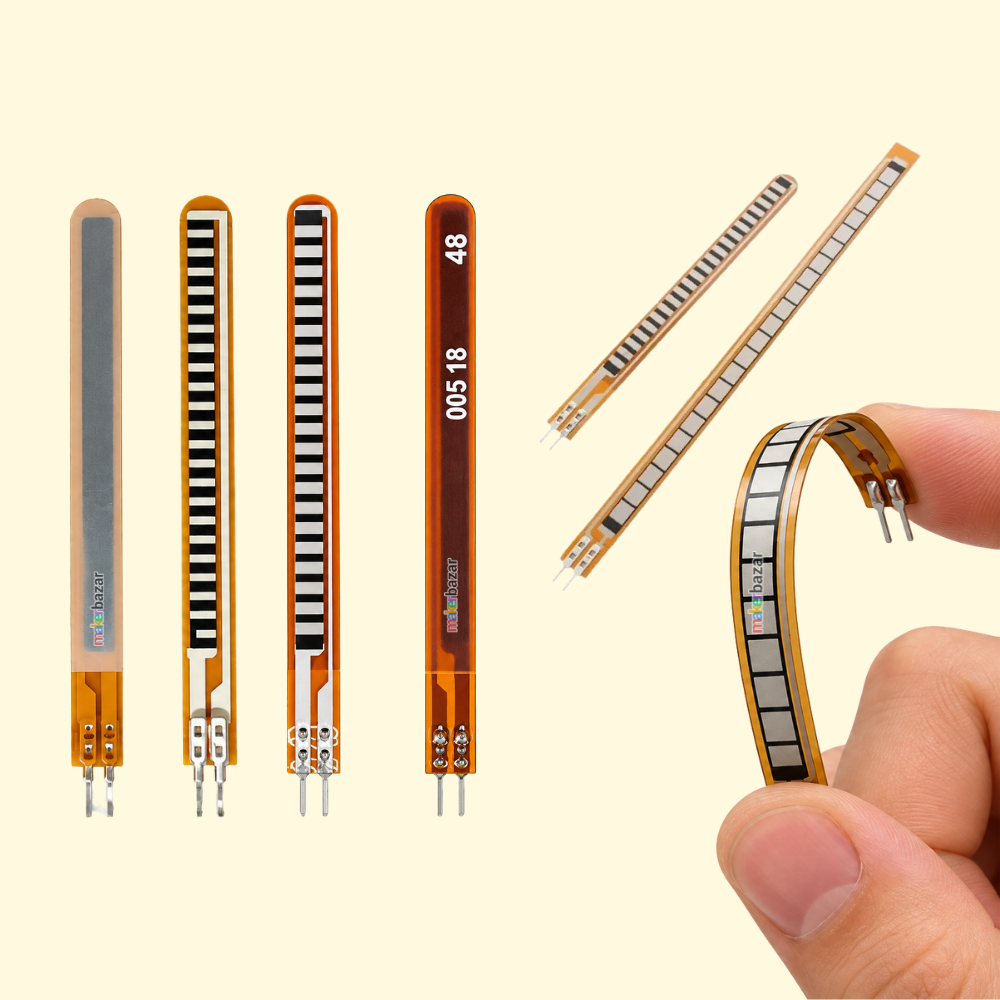
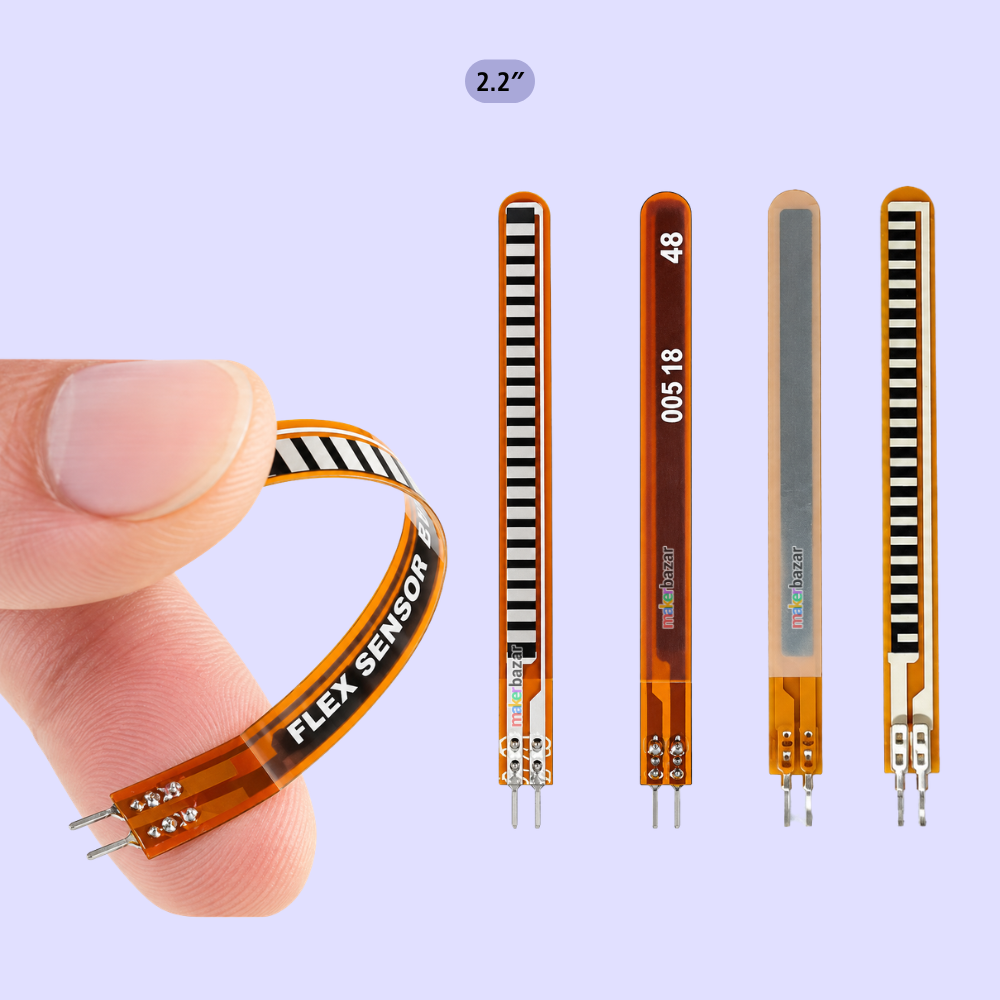
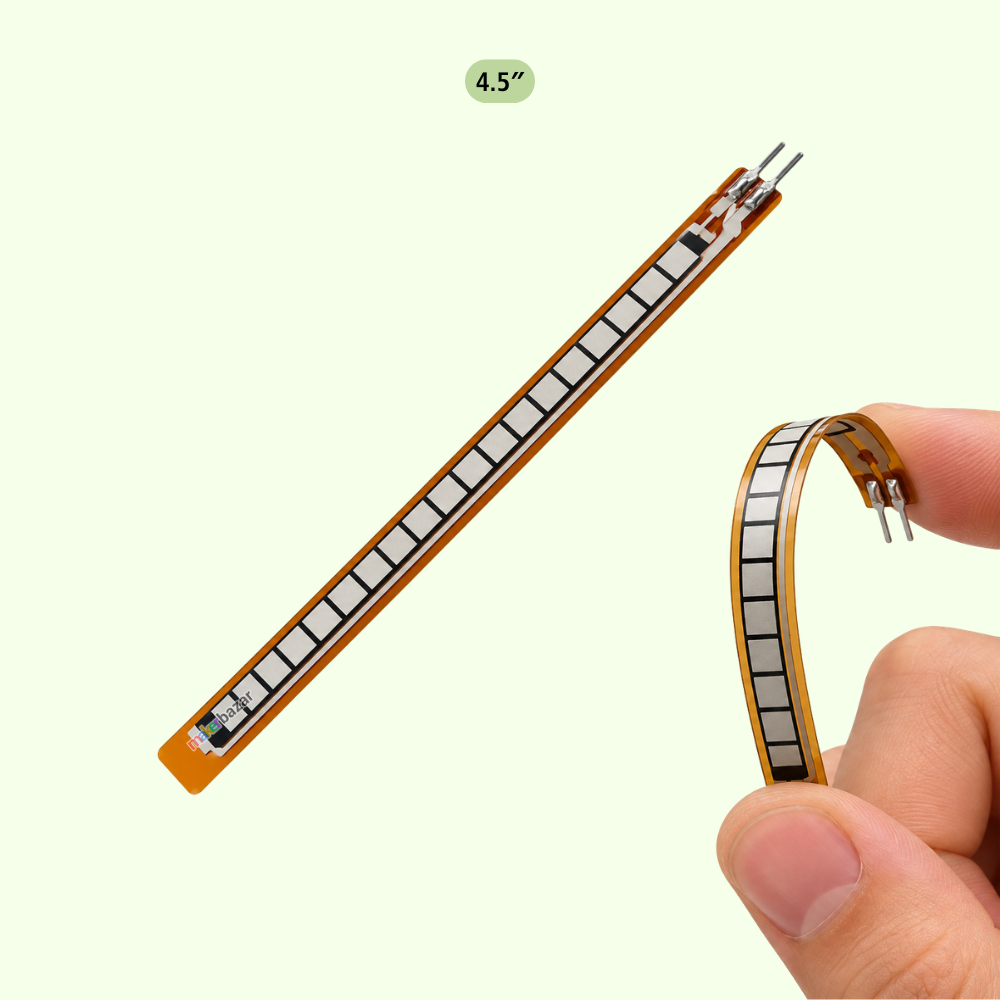
The Flex Sensor Bend Sensor is a flexible resistive sensor designed to detect bending and flexing movements. As the sensor bends, its resistance changes, allowing a microcontroller to measure the degree of bending and convert it into useful motion or gesture data.
The sensor is suitable for hand gesture recognition, robotics, wearable electronics, haptic interfaces, and interactive projects where physical movement needs to be detected electronically.
With its breadboard-friendly 0.1-inch spaced connector, the Flex Sensor can be easily integrated with development boards, microcontrollers, and prototyping circuits.
It can be used with platforms such as Arduino, ESP32, Raspberry Pi, and other microcontroller-based systems through a suitable voltage-divider or signal-conditioning circuit.
Key Features
- Detects bending and flexing movements through resistance variation.
- Resistance increases as the sensing area is bent.
- Suitable for hand gesture and motion recognition applications.
- Flexible sensing element for wearable and interactive projects.
- 0.1-inch spaced connector for breadboard-friendly connections.
- Easy to interface with microcontrollers and development boards.
- Useful for robotics, haptic technology, and motion-controlled systems.
- Suitable for DIY electronics, prototyping, and educational projects.
- Compact design for integration into custom electronic systems.
- Can be used to measure relative bending or flexing angle with suitable calibration.
Technical Specifications
| Specification | Details |
|---|---|
| Product Type | Flex Sensor / Bend Sensor |
| Sensor Principle | Resistive Bend Detection |
| Sensing Method | Resistance Change with Bending |
| Connector Pitch | 0.1 inch |
| Interface | Analog Resistive Output |
| Output Type | Variable Resistance |
| Detection | Bending / Flexing |
| Microcontroller Interface | Analog Input through suitable circuit |
| Suitable Platforms | Arduino, ESP32, Raspberry Pi and other microcontrollers |
| Applications | Gesture Recognition, Robotics, Wearables, Haptic Systems |
| Mounting | Flexible / Custom Integration |
Applications
- Hand Gesture Recognition.
- Robotics and Robotic Arms.
- Wearable Electronics.
- Motion Detection Systems.
- Virtual Motion and Gaming Interfaces.
- Haptic Technology.
- Medical and Assistive Devices.
- Physical Therapy Equipment.
- Computer Peripherals.
- Musical Instruments.
- Interactive Electronic Projects.
- Arduino and Microcontroller Projects.
- Human-Machine Interfaces.
- Educational Electronics Projects.
Precautions
- Do not bend the sensor beyond its recommended bending range.
- The base and connector area are sensitive and may be damaged by excessive bending.
- Bend only the designated sensing area.
- Avoid sharp folds, twisting, or repeated excessive flexing.
- Do not apply excessive mechanical force to the sensor.
- Protect the sensor from moisture, liquids, and corrosive environments.
- Secure the sensor properly when using it in wearable or moving applications.
- Use suitable signal-conditioning circuitry when connecting it to a microcontroller.
- Calibrate the sensor according to the required application for more consistent measurements.